Chester’s city walls are the most complete Roman and medieval defensive town walls in Britain, and walking the full circuit of about two miles is the best way to see the city. It is free, it takes about an hour at a gentle pace, and almost all of it is raised above the streets.
Eastgate Clock, Chester. Photo: W. Bulach, Wikimedia Commons, CC BY-SA 4.0.
Why the walls are special
The Romans began Chester’s defences when they founded the fortress of Deva in the AD 70s, and started rebuilding them in stone around AD 100. After the Norman Conquest the circuit was extended west and south towards the River Dee, and it was complete by the middle of the 12th century. Today the walls are a Scheduled Monument, and almost every section is Grade I listed.
What makes them unusual is that you can still walk right round. The walkway runs for about 1.8 miles and stays above street level for nearly all of its length, dropping down only for a short stretch on the south side.
Where to start
You can join the walls at any of the four medieval gates, Eastgate, Northgate, Watergate and Bridgegate, and at several sets of steps in between. The Eastgate, right in the centre, is a good place to start, and this guide walks the circuit clockwise from there.
Eastgate and the Eastgate Clock
The Eastgate stands on the site of the main entrance to the Roman fortress. The present arch dates from 1768, and the ornate clock on top was added to mark Queen Victoria’s Diamond Jubilee. Designed by the Chester architect John Douglas, it was officially started on 27 May 1899, the Queen’s 80th birthday. It is said to be the most photographed clock in Britain after Big Ben, so expect to queue for a picture on a busy day.
King Charles’ Tower
Head north and you pass the cathedral before reaching the north-east corner and the Phoenix Tower, better known as King Charles’ Tower. A plaque says Charles I stood here on 24 September 1645 and watched his army lose the Battle of Rowton Heath during the Civil War, although some historians think he watched from the cathedral tower instead. The phoenix carved on the tower’s 1613 plaque was the emblem of the city’s Painters’ guild, which leased the tower for its meetings.
Northgate and the canal
The northern stretch is one of the most dramatic. The walls stand high above a deep cutting where the canal runs below, and the Northgate, rebuilt between 1808 and 1810, carries the walkway over the road into the old city.
The Water Tower
At the north-west corner, a spur of wall leads out to the Water Tower, built between 1322 and 1325 by the mason John de Helpston. When it was built it stood in the River Dee, guarding the port and making sure ships paid their dues. The river has long since moved away, which tells you how much the landscape has changed. Next to it is the older Bonewaldesthorne’s Tower.
Watergate and the Roodee
Turning south, the walls run alongside the Roodee, home of Chester Racecourse. Its first recorded race was run on 10 January 1539, and Guinness World Records lists it as the oldest horse racecourse still in operation. On race days the walls make a free grandstand. The Watergate, rebuilt in 1788, once led down to the quays.
Bridgegate and the River Dee
At the south-west corner the Bridgegate, rebuilt in 1781, stands at the end of the Old Dee Bridge, with Handbridge on the far bank. This is the stretch where the walkway briefly comes down to street level before climbing again.
Newgate and the Roman amphitheatre
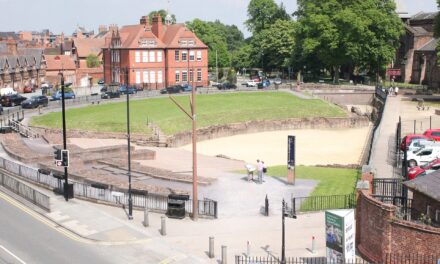
The last section brings you back towards the Eastgate past the Newgate, opened in 1938. Just outside it is the Roman amphitheatre, the largest so far uncovered in Britain. It was only rediscovered in 1929, during work on a garden. Take the steps down for a closer look before finishing your circuit.
Before you go
Chester Life Tip!
The circuit itself takes about an hour. Allow two or three if you want to stop at the amphitheatre, the cathedral or a café on the Rows.
Chester Life Tip!
There are steps at most access points. Handrails to help people with reduced mobility were added at the Watergate in 2022.
Chester Life Tip!
Early morning is the quietest time. A summer evening, when the low sun warms the red sandstone, is hard to beat.
For more on the towers and gates, Visit Chester has a handy guide to the city walls.
…
Exploring further?
From Victorian Hoole to the Dee estuary at Parkgate, our guide to Chester and the surrounding area picks out the places we love most…